Showing posts with label Phantasmagoria Magazine. Show all posts

Wednesday, 30 April 2025

Phantasmagoria Magazine and Crimson Quill Quarterly #6


Two great deliveries today, the latest issues of Phantasmagoria Magazine and Crimson Quill Quarterly. I only have a short piece in what is possibly the most impressive-looking issue of Phantasmagoria so far, but Crimson Quill Quarterly not only contains the first of my two-part story Lies and Treachery, but a truly splendid review of my collection Welgar the Cursed, which ends: "Welgar the Cursed is an extravagant tapestry of the struggle to survive and overcome, led by one of Riley's most compelling characters that I've had the pleasure of reading. One can only hope there is more planned for him in the future."


Monday, 18 March 2024

Phantasmagoria Magazine Hellraiser Special

I received my contributor's copy of the Phantasmagoria Magazine Hellraiser Special this morning. My only contribution is a critical review of Hellraiser: Revelations (2011), which must surely rank as the worst entry in the whole franchise - at least I definitely hope so! 

This is another beautufully produced issue, over 370 pages of stills, drawings, articles, interviews, reviews, etc., with entries by Trevor Kennedy, Peter Atkins, Adrian Baldwin, Simon Bamford, Clive Barker, Imogen Boorman, Tori Borne, Doug Bradley, David Brilliance, Mike Chinn, Malachy Coney, Con Connolly, Kenneth Cranham, Dean M. Drinkel, Kelly Dunn, Terry Farrell, Christopher Figg, John Gilbert, Christopher Gray, Anthony Hickox, Clare Higgins, Dave Jeffery, Carl R. Jennings, Stephen Jones, Paul Kane, Bob Keen, Ashley Laurence, Ivan McCann, Kim Newman, Barnaby Page, Evangelia Papanikou, Geoff Portass, Owen Quinn, Tony Randel, David A. Riley, Andrew Robinson, Helen Scott, Michael Marshall Smith, Jessica Stevens, Nicholas Vance, Nat Whiston, Cliff Wallace, Allison Weir, Sarah Graven Weir, Barbie Wilde, Ciaran Woods and Christopher Young, plus artists Clive Barker, Jonny Boyle, Randy Broecker, Dave Carson, Les Edwards, Graham Humphreys, Allen Koszowski, Ivan McCann, Jim Pitts, Steph Sciullo and Andrew Smith. 

Only £13.35 from amazon

Tuesday, 12 March 2024

Phantasmagoria Magazine Hellraiser Special


Very pleased to have a review in the latest issue of Phantasmagoria Magazine, which is a Hellraiser Special. Ironically, my piece is on what is almost certainly the worst Hellraiser movie ever made: Hellraiser: Revelations. 

To order it from amazon follow this link: Phantasmagoria Magazine Hellraiser Special


Wednesday, 8 March 2023

Sunday, 26 February 2023

Casting the Runes: The Letters of M. R. James

CASTING THE RUNES: The Letters of M. R. James

Edited by Jane Mainley-Piddock

Foreword by Mark Gatiss

Unbound, 2023; Hardcover £25; kindle £15.99

Anyone expecting these letters to be in any way similar to those of H. P. Lovecraft or the recent Hippocampus collection of Clark Ashton Smith’s correspondence with August Derleth, in which, besides discussing subjects of particular interest to the writers, they write about their stories, may be disappointed that there is no mention within any of James’s letters about his ghost stories.

But, I hasten to add, don’t let this put you off, as they are an illuminating glimpse into the everyday life of the author, particularly helped by the notes added after every letter by Jane Mainley-Piddock, which, if anything, are even more interesting than the letters themselves, adding many much-needed background details and facts.

The letters are an easy read, usually written in a chatty, laid-back style. They start with his earliest letters in 1873 and go on to 1927, when he is Provost of Eton.

One of the longest notes goes on to discuss James’s fascination with Charles Dickens’s final, uncompleted novel The Mystery of Edwin Drood and his attempts to find a solution to it, as well as his fondness for detective stories, in particular Conan Doyle’s, which had an influence on the structure of his own ghost stories. Jane Mainley-Piddock’s notes, in fact, are worth the price of the book in themselves, with great insights into James and his stories.

Contrary to what I expected I read the entire volume of over 200 pages within just a few days and was never bored. Definitely something for anyone who loves the ghost stories of M. R. James and would like to read more by and about him.

It comes with a Foreword by James enthusiast Mark Gatis, and an Introduction by the editor.

Reviewed by David A. Riley

This review was read out by Trevor Kennedy on his weekly broadcast on Big Hits Radio UK on Sunday the 26th February 2023, and is also included in Phantasmagoria magazine, Spring 2023.


Friday, 24 February 2023

My review of Casting the Runes: The Letters of M. R. James to be read on Trevor Kennedy's Broadcast this Sunday

My review of Casting the Runes: The Letters of M. R. James, edited by Jane Mainley-Piddock will be broadcast on Trevor Kennedy's radio show this Sunday on Big Hits Radio UK between 12 noon and 2 p.m. 

It will also be included in the next issue of Phantasmagoria, which will be available towards the end of next week.


Thursday, 23 February 2023

Latest issue of Phantasmagoria magazine includes a Tribute to the late Charles Black


I am pleased to announce that the latest issue of Phantasmagoria magazine, due at the end of February, includes a tribute to Charles Black close to the 4th anniversary of his death, with contributions collected by me from Stephen Bacon, Mike Chinn, Kevin Demant, Kate Farrell, Paul Finch, Craig Herbertson, Paul Mudie, Thana Niveau, Reggie Oliver, Marion Pitman, John Probert, David A. Sutton, Anna Taborska and David Williamson. 

It was while I was at Charles's funeral I was told by Kevin Demant that Charles had told him he had intended to start a regular anthology of swords and sorcery stories like the Black Books of Horror. Unfortunately ill health and his death prevented him from ever doing this - which is why I created Swords & Sorceries: Tales of Heroic Fantasy and why each volume is dedicated to him.

Sunday, 12 February 2023

New Monochrome Ad for Swords & Sorceries: Tales of Heroic Fantasy

A new monochrome ad for the Swords & Sorceries: Tales of Heroic Fantasy anthology series has been produced and will appear for the first time in the next issue of Phantasmagoria magazine, due soon. 


Sunday, 18 December 2022

The Triptych of Hell to be published in Lovecraftiana magazine

My Lovecraftian short story The Triptych of Hell is to be published in the Candlemas (February) 2024 issue of Lovecraftiana magazine.

The story was inspired by the collaborative illustration used for the front cover of the Phantasmagoria Magazine's Fantasy Tales Special between Jim Pitts, Dave Carson and Allen Koszowsky. 


Sunday, 4 December 2022

My story After Nightfall reprinted in the Phantasmagoria Fantasy Tales Special

It was nice to see one of my earliest stories, After Nightfall, reprinted yet again, this time in the massive Phantasmagoria Fantasy Tales Special

This story previously appeared in the following:

1970 Weird Window 1, Shadow Publishing edited by David A. Sutton

1971 The Year's Best Horror Fiction 1, Sphere Books & DAW Books edited by Richard Davis

1985 Fantasy Tales #15 edited by Stephen Jones & David A. Sutton

1992 Tayaschiysya Horror 2, (Таящийся ужас 2) published in Russia, translated by Vladimir Vladimirov

2011 Zombies! Zombies! Zombies! edited by Otto Penzler, Vintage Books

2012 Zombies: A Compendium of the Living Dead edited by Otto Penzler, Corvus/Atlantic Books

2013 The Lurkers in the Abyss & Other Tales of Terror, Shadow Publishing

2017 Gallery of Curiosities edited by Kevin Frost

2018 Gallery of Curiosities webzine edited by Kevin Frost

2020 After Nightfall & Other Weird Tales, Parallel Universe Publications

2022 Phantasmagoria Fantasy Tales Special edited by Trevor Kennedy

Friday, 15 July 2022

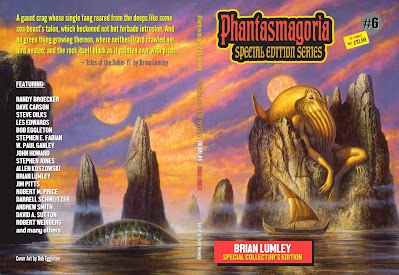
My Retro Review of The House of Cthulhu by Brian Lumley

This review was specially written for the Phantasmagoria Brian Lumley Special.

THE HOUSE OF CTHULHU and Other Tales of The Primal Land

by Brian Lumley, illustrated by Jim Pitts

Weirdbook Press 1984 Hardcover 95 pages

This is a large format book measuring 8¾ inches by 11¼ inches, so although only 95 pages long it’s still quite a good read as each page is roughly the equivalent of 4 in a normal sized book.

Lavishly illustrated throughout by award-winning artist Jim Pitts, The House of Cthulhu contains eleven stories by Brian Lumley plus an Introduction by one of the fictitious characters in it, explaining how the ancient manuscript from a previously unknown civilisation from before the Age of the Dinosaurs was found and translated.

All the tales are set in the fictitious continent of Theem’hdra, the only landmass on the face of the Earth in those distant days, during a time when sorcery still prevailed.  

It’s a well imagined world, complete with a detailed map. It is also, of course, as the book’s title reveals, part of Lumley’s vision of the Cthulhu Mythos. Although I prefer Lovecraft’s original concept than this Derlethian derivation, it works well enough in the kind of swords and sorcery fantasy setting within which these tales take place. Indeed, the title story itself is a remarkable work, including a disturbing and utterly disgusting curse picked up by anyone foolish enough to venture into Cthulhu’s house on R’lyeh, complete with a singularly nasty climax.

One of the things that struck me about these tales is how good Lumley is at depicting interesting and credible sorcerers. The first story, The Sorcerer’s Book is a wonderful tale of a battle for supremacy between a group of them, and, as with many of these stories, has a suitably fitting twist at the end.
How Kank Thad Returned to Bhur-Esh, by contrast has as its main protagonist an exceptionally vicious barbarian. Kank Thad is no Conan. Though strong and violent, he takes unrepentant pleasure in killing his opponents. Which is why, when he is finally apprehended, tried and sentenced, it’s to climb the Ghost Cliffs of Shildakor. All but vertical and mountainously tall, no one has ever succeeded in reaching the summit and freedom before falling to their deaths. But Kank Thad is confident he can manage what no one else could, for “back home as a youth he had used to climb the sea-cliffs for gull eggs with the best of them…” So skilled is he at climbing, even partway up he manages to exact his revenge on some of those who sentenced him, until he finally discovers the cliffs didn’t receive their name without reason…

There are more supernatural menaces in Tharquest and the Lamia Orbiquita, a tale that gets continually darker, while Mylakhrion the Immortal is another yarn of sorcerous treachery, brief but enjoyable in its twists and turns.

Tarra Khash is a regular character in a number of Lumley’s stories, a “bronze-skinned” barbarian “in leather breach-clout and sandals with jewelled ceremonial sword in its long curved sheath strapped to his broad, well-muscled back”. Two volumes of Tarra Khash tales were published by W. Paul Ganley - The Compleat Khash: Volume 1 Never a Backwards Glance and The Compleat Khash: Volume 2 Sorcery in Shad, both illustrated by Jim Pitts.

In Isles of the Suhm-Yi Khash sets sail to a stretch of islands in pursuit of a gang of vicious pirates who have wronged him. This coincides with the annihilation of the Suhm-yi, a strange race of Moon worshippers, by a random cloud of deadly gas. By chance a couple of them survive – though they are fated to be captured by the pirates looking for a hidden treasure whose whereabouts they are convinced the couple know. Combine this with a slumbering god, Gleeth the Blind, and this is quite some tale!

Lords of the Morass is a grisly story of two prospectors who discover the source of a vast hoard of gold. But the people who have access to it worship a monstrous sluglike “gods” that live in the swamp within which the gold can be found. These are possibly the most obnoxious creatures to be found in this book. Despite the horror of these things, though, our prospectors are determined to make themselves rich.

The barbarian Tarra Khash returns in Curse of the Golden Guardians. All but dead after crossing the Nameless Desert he chances across a mysterious old man cooking his breakfast by a large lake in a hollow. Though the two seem destined to become friends, there is something not right about the old man’s explanation of why he is here, nor why he so generously offers Tarra Khash to become his partner in stealing a golden idol. Tarra Khash suspects there is more to the stranger than meets the eye.

Cryptically Yours is in the format of a series of letters between two sorcerers worried about the inexplicable deaths of so many of their confrere. As the letters progress some significant changes take place between them with some typically Lumleyish twists and turns.

The penultimate tale, The Wine of the Wizard starts off in the “present” day. Theired Gustau has concocted a special wine to a recipe found in an ancient manuscript. Unbeknown to him, his nephew, Erik, decides to taste some of it and is immediately overcome by what he thinks is a hallucination – until he realises his mind has been sent back into the body of a young man on the long-lost continent of Theem’hdra where he becomes fascinated in sharing this other person’s life.

The final tale is The Sorcerer’s Dream – which is ultimately a nightmare about the sorcerer Teh Atht, concerned about the alleged immortality of Cthulhu.

All in all, The House of Cthulhu is an entertaining mix of sword and sorcery, outright sorcery and Lumley’s brand of Mythos fiction, tied together in the same primordial setting. Jim Pitts’s illustrations, some of them full page, augment them brilliantly.  

Phantasmagoria Magazine Brian Lumley Special

Saturday, 28 May 2022

ChillerCon May 27th 2022

Jim Pitts and I had a great time yesterday attending Chillercon at the Royal Hotel in Scarborough, where we met up with some old and new friends. 

Trevor Kennedy held a launch and mass signing for the latest Phantasmagoria Special devoted to Brian Lumley. 

Jim Pitts, Steve Dilks and David A. Riley


Sunday, 24 April 2022

Dark Crusade by Karl Edward Wagner - my retro review of this Kane novel

This is my retro review of  Dark Crusade, which was published in the Karl Edward Wagner Phantasmagoria Special

DARK CRUSADE by Karl Edward Wagner

In Dark Crusade we see Karl Edward Wagner’s immortal antihero Kane at his finest – and most evil: honourable by his own idiosyncratic standards, yet capable of carrying out the worst deeds imaginable, heroic yet villainous, courageous yet cruel, indifferent to the suffering of others yet able to reach out and help the most vulnerable on a whim. He is without doubt the most enigmatic character in heroic fantasy.

The novel starts when Orted, the defeated leader of an outlaw band, is on the run after a bungled raid on the city of Ingoldi. Badly wounded, he is fleeing through the labyrinthine alleys of the city when he is offered refuge by a priest of the obscure and unsavoury god Sataki. Though suspicious, Orted is too desperate to quibble. When he follows the priest into his temple, though, he is clubbed senseless and awakens to find himself spread-eagled on a stone altar, about to be sacrificed. Which is when things take an unexpected twist. Perhaps because he is stronger than most of those previously offered by the cult’s priests, instead of being drained of life by Sataki, Orted is filled with some of the god’s spirit. Which is how the outlaw becomes Sataki’s Prophet, a man without a shadow.

The following day, led by Orted, the priests go out into the city to recruit followers at a local market, where most of the crowd are seduced by the demon’s spirit inside Orted and become consumed with hatred for those who refuse their new god. And so begins the Dark Crusade, in which religious fanatics slaughter their enemies, sacking city after city and massacring anyone who fails to follow Sataki.

That is, until this ragtag army meets its first defeat when it comes up against one of the finest armies in the region, whose heavy cavalry turn its advance into a panic-filled rout.

Which is where, ever the opportunist, Kane comes in.

The Immortal Swordsman uses the Prophet’s defeat to offer his skills to him as a general to train the mob into the semblance of a real army, at the same time using Orted’s plundered wealth to hire mercenary cavalrymen who will be loyal to him, not the cult. Kane cynically intends to use what the Prophet has created to carve out an empire before assassinating Orted and taking everything for himself.

Or so he hopes.

As a foil to Kane, we have the general Jarvo, who begins the story as the arrogant leader of the cavalry that defeats Orted’s mob. Already hideously scarred by Kane after he tried to have the swordsman removed as a rival to power when they were members of the same army, he is unexpectedly defeated when he again attacks the Prophet’s army, unaware of the changes Kane has made in the meantime - or the mercenary cavalry Kane has recruited. But Jarvo proves difficult to kill and miraculously, if painfully, begins to recover from the injuries he sustains at the battle. Afterwards he helps to forge a new alliance amongst neighbouring kingdoms to oppose the Crusade.

This is an involved story, with intricately woven power struggles in a barbaric world. Kane treads the chasm between hero and villain superbly well. Though he is thoroughly amoral there is, bizarrely, something almost heroically noble about him. Orted’s possession by the demon Sataki is credibly described, still a man beneath the alterations wrought upon him. And his crusade, though filled with fanatical violence, is credibly disparate, filled with the kinds of greed and opportunism that are all too easily recognisable.

Though set within a fantasy world, this is a book that has whispers of the real world in it – and lessons about the ongoing dangers of religious zealots. It is also incredibly well written and a great read. 


 Phantasmagoria - Karl Edward Wagner Special